HGV defects explained: drive it or park it?
Every defect on a walkaround comes down to one call: is this vehicle legal and safe to drive, or not? Here's how DVSA actually categorises faults, what a prohibition means, and where to check yours, in plain English.
The three outcomes, in practice
| Outcome | What it means for you |
|---|---|
| PARK IT, immediate prohibition | The defect is a danger now. The vehicle doesn't move again (except as directed) until it's fixed and the prohibition is cleared. |
| FIX IT FIRST, delayed prohibition | Serious, but not an on-the-spot danger. The prohibition takes effect after a set time, often ten days, and the fault must be put right before it bites. |
| RECORD IT, advisory | Legal to drive today. Write it on the defect report, plan the fix, and don't let it become next month's prohibition. |
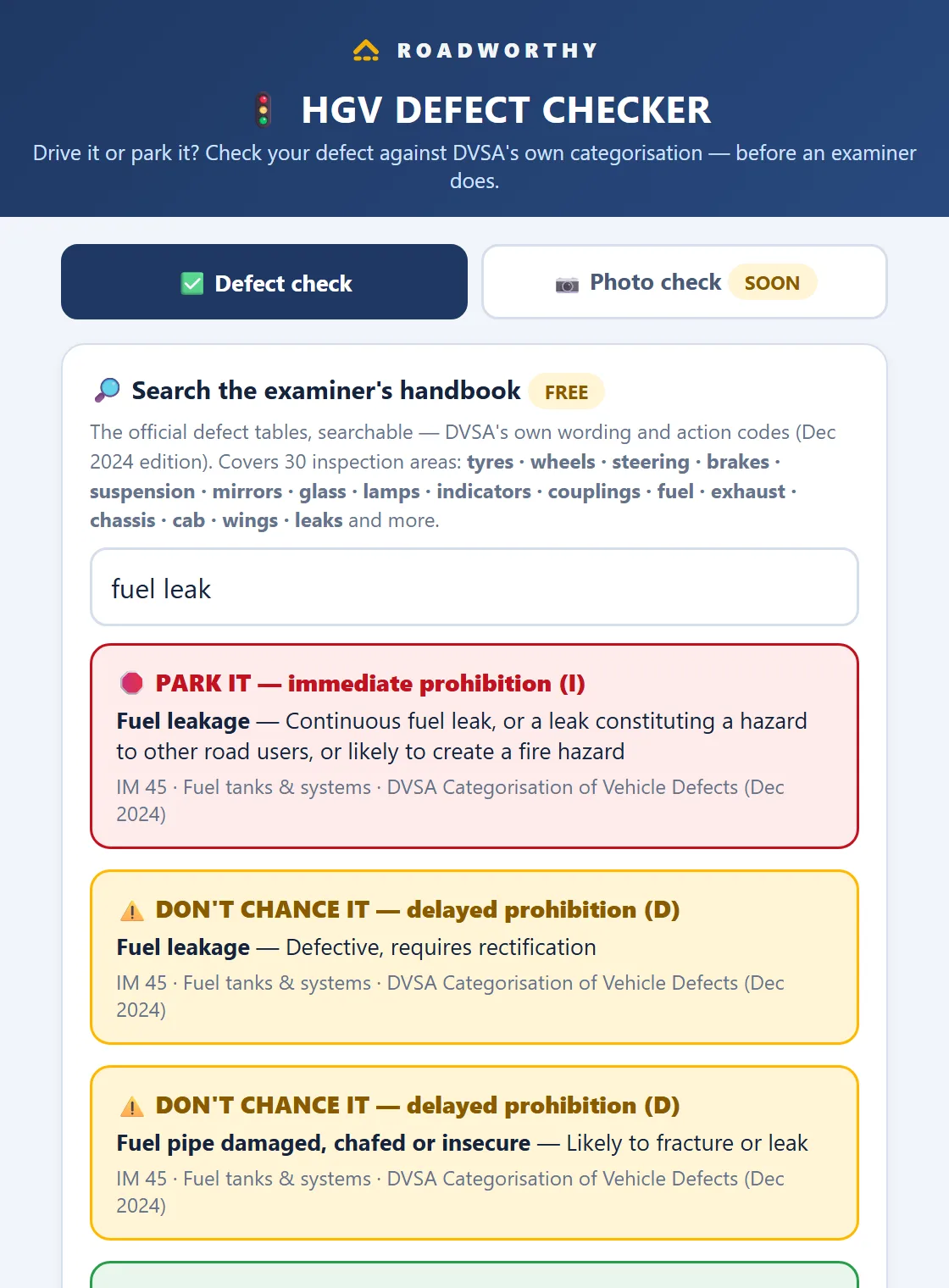
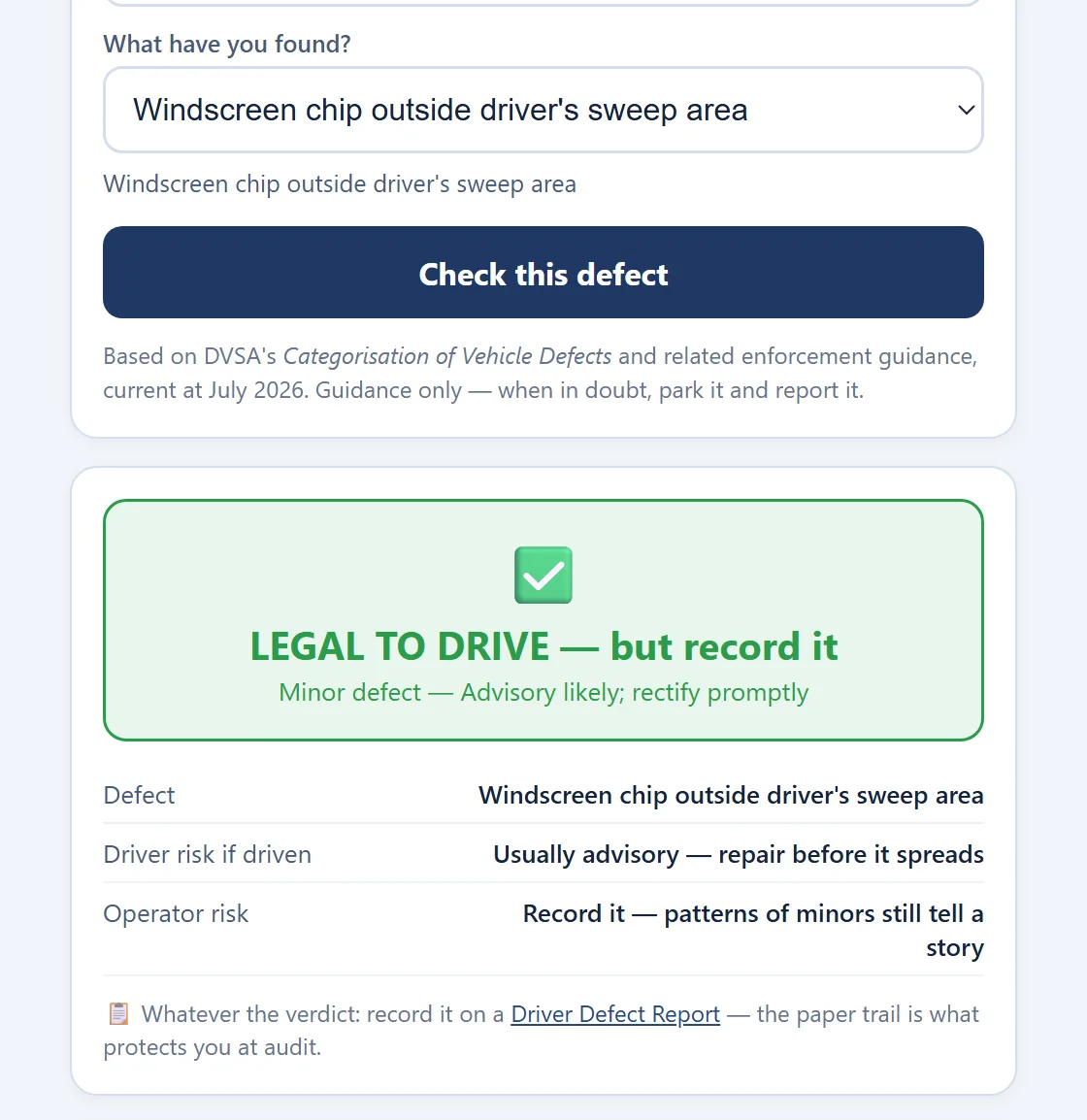
The same fault can land in different buckets depending on severity and circumstances, one dim marker lamp in daylight is a world away from both brake lights out at night. That's why the categorisation runs to a whole handbook, and why our checker exists: pick the defect, get the likely category, straight from DVSA's own tables, 3 checks free.
What a PG9 actually is
A PG9 is the prohibition notice itself, the piece of paper that legally stops the vehicle being used. Ignoring one is prosecution territory, and every prohibition lands on the operator's compliance record, which raises the odds of being stopped again. A prohibition doesn't lapse on its own: the defect has to be fixed and the prohibition formally removed, with proof of repair and sometimes an inspection. The clean version of this story, spotting the fault on your walkaround before DVSA does, costs a defect-book entry and a fitter's hour.
The common calls, area by area
Tyres
The one everyone half-remembers: the HGV limit is 1mm, not the car's 1.6mm, but measured across the middle three-quarters, all the way round. Cords showing, deep cuts or bulges are instant PARK ITs regardless of tread, and the court fines you per tyre, an unlimited fine on a goods vehicle over 3.5 tonnes, plus 3 penalty points.
→ Full guide: the legal tread depth for an HGV
Lights, mirrors and view
Mostly FIX IT FIRST territory, but it hinges on whether you still have a safe view and a working signal, and whether you're driving in the dark. Both brake lights out is a PARK IT; a hairline-cracked mirror with a clear view is usually fine to fix at the depot.
→ Full guide: cracked mirror or dead lamp, drive it or park it?
Brakes, leaks and load
The heavy hitters. An ABS/EBS warning lamp that stays on is a FIX IT FIRST with a delayed prohibition common. Oil or grease leaking onto brakes, tyres or the road, including hub oil on trailers, is an immediate PARK IT. An insecure load is treated as the danger it is: don't move until it's restrained.
→ Check any specific fault in the HGV Defect Checker, 3 free checks
The paper trail
The walkaround check keeps the vehicle safe; the record keeps the operator's licence safe. Who checked what, when, what they found, including nil defects, and what was done about it, kept for at least 15 months.
→ Full guide: what a walkaround check must record
What happens at a DVSA roadside stop
Documents and tacho first, then the vehicle: tyres, lights, brakes lines and couplings, load security, leaks, the same list your walkaround covers, which is not a coincidence. The examiner categorises anything found against the handbook and issues the outcome on the spot. Two things consistently help the driver standing there: a defect book that shows today's check was done, and being able to say what you found and what was done about it. Silence and a blank book read the same way to an examiner: nobody looked.
Found something on your walkaround?
Get the drive-it / fix-it / park-it call and the likely penalty in seconds, 3 checks free, from DVSA's own categorisation. Then record it properly with the walkaround pack.
Try 3 free checks → See the walkaround packBased on DVSA's Categorisation of Vehicle Defects (examiners' handbook), the Guide to Maintaining Roadworthiness and related enforcement guidance, current at July 2026.
Guidance only, not legal advice. Categorisation at the roadside is the examiner's decision on the day, and rules change; always work to current DVSA guidance. Roadworthy is an independent tool provider and is not affiliated with, or endorsed by, DVSA. Contains public sector information licensed under the Open Government Licence v3.0.